Wednesday, May 1, 2013

Project Summary

Here is a summary of our grid computing results. The total run time is six days, eleven hours and 57 minutes. The points generated thus far are 28,983 out of 355,272. Result returned is ranked 41 out of 409,263. 


Although this service learning project is different from traditional service learning projects, we thoroughly enjoyed contributing our computer power toward research and helping in ways that would not otherwise be possible with the traditional service learning projects.

We will continue run the grid even after the semester is over.

Friday, April 19, 2013

Cervical Cancer Questions Answered


Questions – Cervical Cancer
 
These questions address the Journal of Infectious Diseases article entitled “Evolutionary Ecology of Human Papillomavirus: Trade-Offs, Coexistence, and Origins of High-Risk and Low-Risk Types” by Orlando et al. (2011).  Be sure to explain your answers.
 
  1. On page 1, the authors describe two patterns of selection on the quantitative trait virulence.  Name these two patterns, described below:
a.       “Natural selection often favors intermediate phenotypes”
a.       Stabilizing
b.      “…some ecological circumstances may promote extremes of persistence or virulence”
a.       Disruptive
  1. Apply Darwin’s postulates to HPV populations in human hosts (see page 2 for guidance).
    1. There is variability in traits- There is variability in the types of HPV: LR and HR and they each have a difference in virion production and the course in which each types takes within the host
    2. Some traits are heritable: The virulence (number of virions produced) can be passed on to the next generation
    3. Not everyone will survive- There will be more HPV that will be produced than will survive
    4. Natural selection will occur-  According to the paper, natural selection favors intermediate phenotypes of HPV (in between HR and LR types)
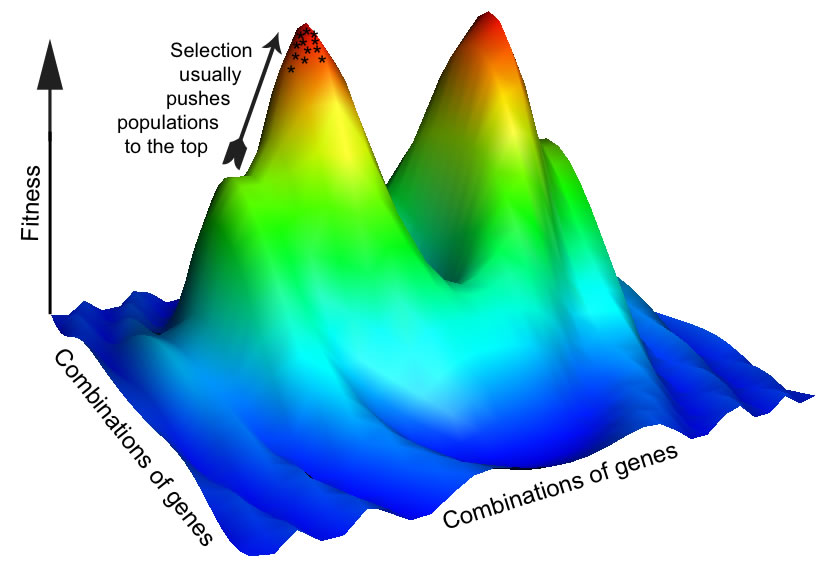
  2. What is an adaptive landscape (sometimes called a Wrightian landscape)?  Please include a 3D figure (with citation).
 

http://evolutionarysystemsbiology.org/intro/adaptive_landscape_labelled.jpg
  1. The authors define Evolutionarily Stable Strategies on page 4.  Can you please explain ESSs in understandable terms?
    1. In a stable environment, the evolutionary competitive strategies adopted by the majority of the population become fixed and prevents alternative strategies of infecting hosts from successfully entering the population. The number of resources is dependent on the variation of the HPV strains and each individual strain’s fitness is determined by the number of resources and in this case, resources refer to the number of individuals susceptible to HPV infection.
  2. Given the paper’s conclusion (see page 7), what would you predict about the efficacy of HPV vaccines? 
    1. In the paper they discussed that HPV evolves slowly estimated at a rate of 1% nucleotide change per 100 000 to 1 000 000 years. From this, we predict that HPV vaccines will be more accurate in combating the current strains before they get a chance to evolve.
  3. Why should an OB/GYN know about evolution?
    1. An OB/GYN should know about evolution, especially for HPV, because based on their patients’ sexual behavior, OB/GYN’s can determine the typical strain that the patient will have and can treat accordingly.

Tuesday, March 26, 2013

Saturday, February 16, 2013

A Physician's Perspective on HPV and Cervical Cancer

Let's Talk to The Expert! 

      This week we had the opportunity to interview Dr. Brendan Bradley Mitchell, MD. Dr. Mitchell began his residency in 1991 and eventually started his clinical practice specializing in women's care (Obstetrics & Gynecology) in 1994. With a great sense of humor, and a kind, relaxed attitude he was more than willing to meet with us on campus here at Rockhurst for lunch. He gave us honest, open answers on his experience with cervical cancer, its development, and exposure.

      Dr. Mitchell began by explaining that he chose his specialty because he loved the broad range this medical field had to offer, and of his particular interest in delivering infants. Our questions then turned on a more serious note. He then described that cervical cancer is not very prevalent (Dr. Mitchell sees 6-10 cases a year) and is dependent on an individual's background and sexual experience. However, he does diagnose HPV daily. People who develop cervical cancer usually haven't been going to the doctor.Detection for HPV starts young because people are becoming increasingly sexually active at a younger age. Pap smears are an important tool for early detection of possible cervical cancer/HPV cases, and Dr. Mitchell really stressed their importance.

      According to Dr. Mitchell, HPV is the leading cause of head and neck cancers. It also causes anal cancer and may lead to cervical cancer. There is a positive correlation between how sexual active a person is and their chance of getting HPV, and this virus may be transmitted from mother to child. 

      Dr. Mitchell then spoke about a few symptoms of HPV infection such as genital warts. He said that HPV was not restricted to any particular demographic, but rather to an individual's lifestyle. Unfortunately, condoms do not completely prevent the transmission of this virus because it can be transmitted through skin contact. Also, HPV vaccines (such as Gardasil) do not protect against all strains of the virus. 

      The treatment of HPV varies. For example, a woman who plans on having children in the future would have a different treatment plan when compared to a woman who does not. A laser treatment is used for mild dysplasia, and surgical treatment (excision) is used for major dysplasia. The excision process involves extracting the abnormal cervical cells. Afterwards, the patient is monitored by taking biopsies to check for any precancerous tissue.

We wanted to interview with Dr. Mitchell to get an understanding of a doctor's firsthand exposure to cervical cancer, his experiences with it, and maybe get to learn about how the women patients feel about cervical cancer. Reflecting on the interview, it doesn't appear that many women in the hospital where Dr. Mitchell works deal with the misfortune of cervical cancer very much, thankfully. Knowing that there are REAL  preventative measures against this type of cancer is reassuring.

This interview help us to become more familiar with treatments pertinent to cervical cancer. We noted that Dr. Mitchell said the HPV vaccine doesn't protect against all strains of HPV. Here, evolution plays a major role, mutating the strains of HPV so that some may be resistant to the vaccine and survive and proliferate. The same goes with the cancer itself. Evolution changes the cervical cells and causes it to grow out of control.

Our grid computing project aids to the research of cancer. From this, we hope that we can add to the knowledge base of all types of cancers. 

      We thank Dr. Mitchell for his time and expertise on the matter. The interview was both informative and interesting. We appreciate Dr. Mitchell's ability to both humor and educate us about this important matter at the same time. To reiterate, prevention of cervical cancer is extremely important, and for this reason regular check-ups are essential. For information, we implore you to visit the cervical cancer page on the National Cancer Institute-National Institutes of Health (NCI-NIH) webiste: http://www.cancer.gov/cancertopics/types/cervical


Thursday, January 24, 2013

Cervical cancer


What grid computing application did we participate in? 

Our group decided to link up to the  application Help Conquer Cancer. The structure of a protein after it is folded reveals many important aspects of that protein including how it interacts with other proteins. The Help Conquer Cancer project is using X-Ray Crystallography, instead of simulated folding, to determine unknown protein structures.

 X-Ray Crystallography is a complicated procedure in which x-rays are sent through crystallized proteins to predict their structure. In order for this to work correctly, the target protein must be correctly crystallized. To get a well-formed crystal, the experiment needs to be performed many times on each protein while altering several different conditions.

 The computer power of WCG comes into play to analyze 86 million images from 9400 proteins to see which images contain well formed crystals. The well-formed crystals can then be used to determine the structure of the protein. Also, by figuring out which conditions created good crystals, X-Ray Crystallography techniques can be improved.


What is cervical cancer?

Cervical cancer is cancer that starts in the cervix, the lower part of the uterus (womb) that opens at the top of the vagina.There are two types of cells on the cervix's surface: squamous and columnar. Most cervical cancers are from squamous cells.Cervical cancer usually develops very slowly. It starts as a precancerous condition called dysplasia. This precancerous condition can be detected by a Pap smear and is 100% treatable. It can take years for precancerous changes to turn into cervical cancer.
Cervical cancerCervical cancerCervical neoplasia
Cervical biopsyThe Pap smear

What are the causes?

Almost all cervical cancers are caused by HPV (human papilloma virus). HPV is a common virus that is spread through sexual intercourse. There are many different types of HPV. Some strains lead to cervical cancer. (Other strains may cause genital warts, while others do not cause any problems at all.)

The U.S. National Library of Medicine list a couple of risk factors.Risk factors for cervical cancer include:Not getting the HPV vaccinePoor economic statusWomen whose mothers took the drug DES (diethylstilbestrol) during pregnancy in the early 1960s to prevent miscarriage
Weakened immune system

What are the symptoms of cervical cancer?

Most of the time, early cervical cancer has no symptoms. Symptoms that may occur can include:Abnormal vaginal bleeding between periods, after intercourse, or after menopauseContinuous vaginal discharge, which may be pale, watery, pink, brown, bloody, or foul-smellingPeriods become heavier and last longer than usualCervical cancer may spread to the bladder, intestines, lungs, and liver. Patients with cervical cancer do not usually have problems until the cancer is advanced and has spread.

Symptoms of advanced cervical cancer may include:Back painBone pain or fracturesFatigueLeaking of urine or feces from the vaginaLeg painLoss of appetitePelvic painSingle swollen legWeight loss

What can you do to prevent cervical cancer?

Most women who are diagnosed with cervical cancer today have not had regular Pap smears or they have not followed up on abnormal Pap smear results. Early detection is key! Get your annual Pap smear. Smoking has also been identified to increase the risks of cervical cancer so that's another reason to quit smoking!

A vaccine to prevent cervical cancer is now available. In June 2006, the U.S. Food and Drug Administration approved the vaccine called Gardasil, which prevents infection against the two types of HPV responsible for most cervical cancer cases.

Studies have shown that the vaccine appears to prevent early-stage cervical cancer and precancerous lesions. Gardasil is the first approved vaccine targeted specifically to prevent any type of cancer.

Practicing safe sex (using condoms) also reduces your risk of HPV and other sexually transmitted diseases. HPV infection causes genital warts. These may be barely visible or several inches wide. If a woman sees warts on her partner's genitals, she should avoid intercourse with that person.

To further reduce the risk of cervical cancer, women should limit their number of sexual partners and avoid partners who participate in high-risk sexual activities.

All of the above information came from the U.S. National Library of Medicine. For the full article, click out this link.